
Earlier this week, a paying customer almost lost trust in one of my products – not because of a bug, bad support, or slow updates.
It happened because of a missing FAQ.
Yes, something as small as one unanswered question nearly cost us a customer. And if you think that sounds dramatic, wait until you hear the story.
The Question That Started It All
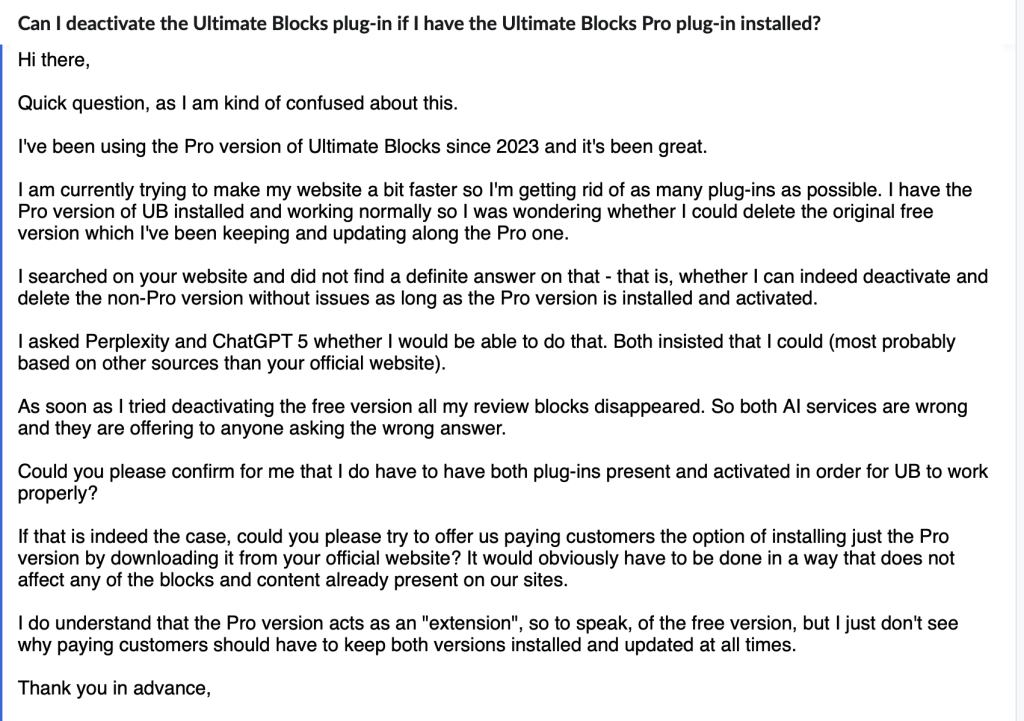
A customer had been using the Pro version of Ultimate Blocks since 2023. They loved it. But recently, they wanted to speed up their site and cut down on plugins.
Here was their question:
“I have Ultimate Blocks Pro installed. Can I delete the free version without losing any functionality?”
Pretty reasonable, right?
They searched our website. No clear answer.
They asked AI tools like Perplexity and ChatGPT. Both confidently said:
“Yes, you can.”
So they deactivated the free version.
And then?
Every single Block on their site disappeared.
When AI Gets to Answer for You
The customer quickly realized something was wrong. They emailed us directly, frustrated — not just because their site was broken, but because AI had misled them.
Now, here’s the thing: they weren’t wrong to trust AI. People do trust it. And when they can’t find an answer on your site, they’ll happily let AI “fill in the blanks.”
The problem?
If your product doesn’t have a clear FAQ addressing the question, AI will guess. And sometimes, it will guess wrong.
In this case, the correct answer was simple:
Ultimate Blocks Pro works as an extension to the free version. You must have both installed and active.
But because that information wasn’t in our docs, AI had no reliable source to pull from — so it invented an answer that broke the customer’s site.
Missing FAQs Are No Longer Just a “Support” Problem
Before the AI era, a missing FAQ meant:
- A frustrated customer might open a support ticket.
- Maybe they’d post on a forum.
- Worst case, they’d churn quietly.
Now?
A missing FAQ is an AI content problem.
When people ask ChatGPT, Claude, Gemini, or Perplexity about your product, those tools don’t magically know the answer – they rely on whatever content they can find online. If your site doesn’t have the answer, they’ll make one up, often based on how similar products work.
And that means:
- Wrong answers spread faster.
- Your product’s reputation gets shaped by guesses.
- You lose customers without even knowing why.
How to Stop Losing Customers to Missing FAQs
Here’s what I learned (the hard way):
- Treat FAQs as AI training material
Don’t just write them for customers — write them knowing AI will use them as reference. - Add FAQs to your public docs
Public, crawlable pages (with clear headings) are more likely to be picked up by AI tools than hidden helpdesk articles. - Identify “invisible” questions
These are the questions customers ask in tickets, chats, or emails but can’t find on your site. If they’re asking you directly, they probably tried AI first. - Be exact, not vague
“In most cases” or “should work” are AI poison. Be definitive, especially for technical compatibility questions. - Use FAQ schema
Structured data helps search engines and AI models understand and trust your answers.
The Bottom Line
In 2025, FAQs are not optional extras you publish once and forget. They are a living, breathing part of your product’s AI-facing presence.
If your FAQ section doesn’t answer a question, AI will. And if AI gets it wrong, your customers will suffer — and you might never even know why they left.
So before you spend another week building a new feature, ask yourself:
Have I answered every important question my customers (and AI) might ask?
Your future customers and your support team will thank you.
Recommended Reading: Why You Should Publish More Documentation of Your Product Now Than Before
Leave a Reply